















Our Approach
Aditya Birla Group’s sustainability journey has been one of continuous evolution from establishing a strong foundation to integrating Sustain-Ability into business strategy and now moving towards unlocking enterprise value through sustainability. Over time, our approach has matured through three strategic phases: Sustainability 1.0, 2.0, and now building on 3.0, each block building on the previous to align better with business priorities, global expectations, and solidifying us as 'a Force for Good.'


Sustainability 3.0
Traditional approaches to sustainability have been rooted in risk mitigation and regulatory compliance, essentially protecting existing value. While necessary, this defensive posture fails to capture the transformative potential of sustainability as an engine of innovation and market differentiation. Our Sustain-ability 3.0 framework represents a fundamental shift, from managing downside risks to unlocking upside opportunities, from value protection to deliberate value creation.
Through Sustainability 3.0, we are embedding ESG in the core of our business models as a catalyst for innovation, competitiveness, and long-term growth.
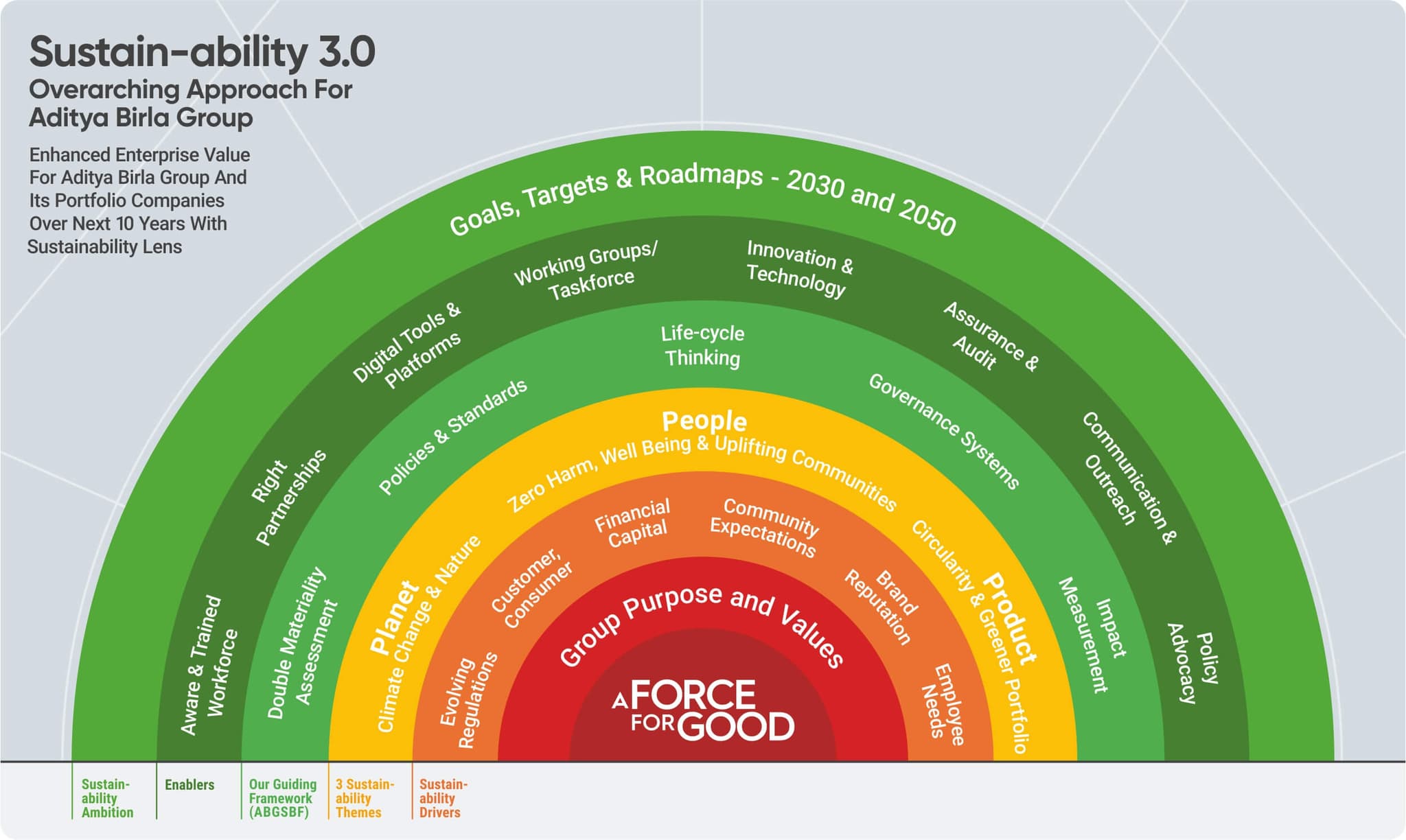
At its foundation is our Group purpose of enriching lives by building dynamic and responsible businesses and institutions that inspire trust. Guided by our values of Integrity, Commitment, Passion, Seamlessness and Speed.
Thematic Areas
The framework rests on three themes that shape both impact and enterprise value:

Planet
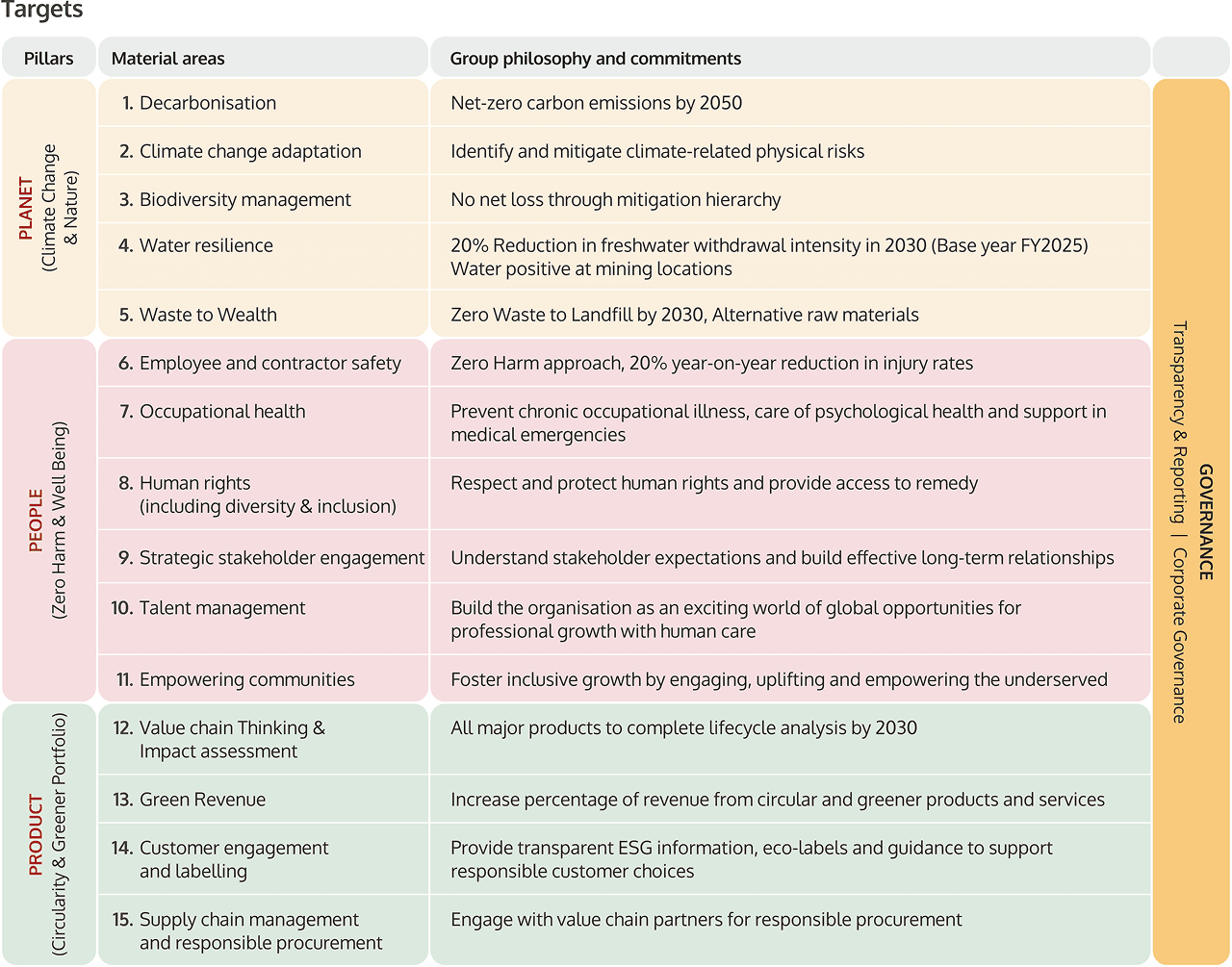
The Planet theme addresses climate change and nature, focusing on material areas: decarbonisation, climate adaptation, biodiversity management, water resilience and waste-to-wealth.

People
The People theme centres on zero harm and well-being. It encompasses employee and contractor safety, occupational health, human rights and inclusion, strategic stakeholder engagement, talent development and community empowerment.

Product
The Product theme advances circularity and a greener portfolio. It integrates value-chain thinking, product stewardship and customer engagement.
Our Goals & Roadmap
The Group’s ambitions are translated into time-bound sustainability targets for 2030 and 2050, providing a clear roadmap for action. These targets are organised around the three integrated themes—Planet, People and Product—reflecting the interconnected nature of environmental stewardship, social responsibility and business transformation.
How we deliver Sustain-ability 3.0
The approach is anchored in the Aditya Birla Group Sustain-ability Business Framework (ABGSBF), which provides a consistent and scalable architecture across businesses and sectors. The framework integrates five essential building blocks:

Double Materiality Assessment
To align priorities with business risks, opportunities and societal impact

Policies and Standards
To embed sustainability into core business processes

Life-Cycle Thinking
To extend focus from sites to products and value chains
Governance Systems
To ensure strong oversight, accountability and decision-making
Impact Measurement
To consistently track progress, outcomes and value creation
Delivering Sustain-ability 3.0 is underpinned by a strong ecosystem of enablers. These include building an aware and capable workforce, partnering with the right organisations, deploying digital tools and platforms, forming cross-functional working groups and taskforces to accelerate innovation and technology deployment, strengthening assurance and audit mechanisms, and investing in communication, outreach and policy advocacy.
Together, these elements enable the Group to respond proactively to an evolving regulatory landscape, growing customer and investor expectations, and rising social and environmental challenges. Sustain-ability 3.0 positions Aditya Birla Group not only to manage risks, but to unlock new opportunities, reinforce trust, and create enduring value while advancing its role as a Force for Good.
Sustainability 2.0
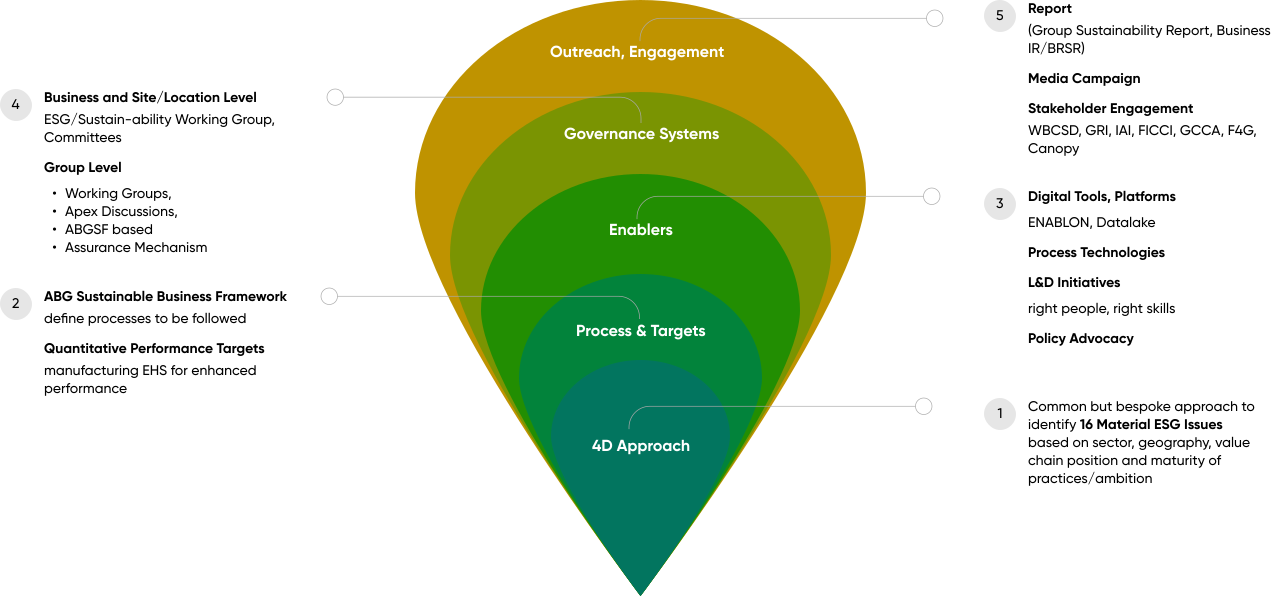
In 2020–21, the group introduced Sustainability 2.0, a shift from systems-building to embedding ESG into business strategy. At the heart of this model lies the 4D Approach, which helps businesses identify and act on material ESG issues based on their sector of operations, geography of operations, value chain position, and maturity of practices.

D1
Sector of Operations

D2
Geography of Operations

D3
Value Chain Position

D4
Time Horizon/ Maturity of Practices
By adopting a strategic and integrated approach to the double materiality assessment process, the Group identified and defined 16 material ESG areas, established targets and processes for those areas and used the key enablers to deliver on the set targets and goals by applying a strong governance mechanism to track, monitor and assess hinged on ABG SBF.
These material areas formed the common minimum ESG agenda at the Group Level, mapped against stakeholder expectations and global frameworks. The focus in 2.0 moved from internal alignment to external value chain impact, with Group-level ESG performance targets introduced to drive measurable progress.
We worked towards the performance targets in Group businesses across all locations through well-defined action plans.
The enablers form the backbone of all the action plans:
- Deploying right technologies including processes in addition to use of digital tools;
- Having the right people for the right job through enhanced learning and development;
- Ensuring right systems are in place;
- Providing and maintaining right assets and equipment;
- Drawing the right partnerships and platforms that create synergies.
Sustainability 1.0
Launched in 2012–13, Sustainability 1.0 focused on developing governance systems, risk management processes, and performance standards across the Group through a funnel-based approach sitting on 3 pillars:
ABG Model For Sustainable Business

This model was supported by the ABG Sustainable Business Framework (SBF). The ABG SBF comprises 19 policies and their associated 67 Technical and 18 Management Standards, which set the expectations and worked towards guiding management system improvements across our Group companies. Furthermore, 72 Guidance Notes were made available to support the practical implementation of requirements across the Group. Maturity was tracked through Self-Assessment Questionnaires (SAQs), which provided a structured pathway to raise performance levels.